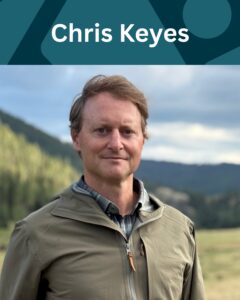
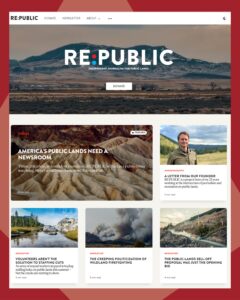
 Chris Keyes steered the editorial ship at Outside as Editor in Chief from 2007 to 2021 and as the Vice President of the Outdoor Group from 2021 to 2025. He is a journalist’s journalist and treats the craft with the utmost respect. I had the pleasure of writing for him for over a decade and was always blown away by how focused and smart he was in every single meeting we had together. He started RE:PUBLIC in April of 2025. It is a nonprofit, nonpartisan newsroom with a sole focus: to deeply report on public lands. We caught up with him after his fantastic talk on Switchback’s webinar called Lay of the Land: Protecting Our Public Lands and Water (link here in case you missed it), where Keyes spoke with The Conservation Alliance about RE:PUBLIC, the current state of public lands, and what the outdoor industry can do to help.
Trailheads: You spent years covering an extremely wide range of outdoor topics as the Editor in Chief at Outside. What made you go all-in on public lands?
Keyes: “There’s a couple reasons for that. One was just really a deep dive studying the nonprofit journalism space and the various models that are out there. And you have your national broad in scope like ProPublica, and then you have a lot of hyper local news to fill in the gaps where newspapers have disappeared. And then the third way is national in scope, but single topic focused. I really liked that model. There is something liberating about having a single topic of focus, really focusing your efforts so that you know exactly which stories you will tell and you won’t tell. So that was number one.
And then number two was, I recreate on public lands every day. Whether it’s county lands or federal lands or state lands, I’m recreating on them every day. When I was at Outside during the first Trump administration, our public lands coverage were the most popular stories that we produced in that era. I know that this brand and others don’t have the reporting capacity to do those kinds of stories anymore. So, I just saw a real need and a niche because there’s so many threats to these lands right now and not enough coverage and people just aren’t aware of what’s going on.”
Trailheads: Why do you see this moment as particularly urgent for public lands?
 Keyes: “There’s this huge, broad coalition that wants to protect these places, but over the last 25 years, conservation and environmentalism have been coded as left, and it’s been sort of tossed into the culture wars as signaling lefty causes. If you go back and look at the history of the environmental movement, it was a very broad-based bipartisan support in the ’70s. I mean, much of our major legislation was passed under Nixon.
So, we know that this coalition is out there. But at the same time that it’s been coded that way, I think the conservation movement and advocacy groups have been speaking in an echo chamber and talking to the same audience that really cares passionately about these things, but not trying to reach out beyond that across the political spectrum. So I think the coalition is there for the taking, but it has to be built and it has to be carefully built in order to find durable solutions so that we’re not talking about the same issues decade after decade. We’re protecting these things for perpetuity.”
Trailheads: You’ve written that public lands don’t always need to be framed as a climate issue. What do you mean by that?
Keyes: “That’s another thing that I’ve seen over the course of my career. I think when I first got into journalism in the early 2000s, there was a lot of environmental journalism writ large. And I think over the last two decades, so much of the funding for environmental journalism has been around climate change journalism. And as I say repeatedly, I’m not knocking that. I believe it’s the biggest issue of our time, but I am also very clear, eye to eye, about the fact that we’ve lost the messaging battle around climate change. And so if you’re telling all of your stories and why these things are important through that lens, you’re missing this broader coalition that you need.
When you talk about public lands, you can talk about economic issues. The recreation economy is huge and enormous and supports all of these smaller communities out west in ways that have never been factored in before. You can talk about the public health benefits of just access to nature that we can’t lose and we can’t afford to lose in this time. You can talk about sound preservation and management of our forests for wildfire protection. These are things that aren’t necessarily environmental stories at their heart, and so you can reach a broader audience.”
Trailheads: You also describe this as a community issue. How should retailers think about that?
Keyes: “Take the boundary waters. You think about the surrounding towns that have this enormous recreation infrastructure that supports all the people that want to head out into the boundary waters. That represents millions and millions of dollars. If you threaten the quality of the water and the boundary waters and essentially ruin it with a mining project, those communities are damaged permanently. That’s where I think you can look at place after place that are under consideration, whether it’s for oil and gas lease sales or new mining leases. We are overlooking the communities that are impacted by some of those short-term projects, and that’s where I get to the community idea.”
 Trailheads: Why should this matter right now for outdoor specialty retailers?
Keyes: “If you look where the people who are purchasing gear are recreating, most of it is on public land. We need to save these spaces if you want a business. I think more importantly, just in terms of talking about these issues now, is that this administration is pushing a radical agenda. We did a story on the Maah Daah Hey Trail in North Dakota. It’s an iconic bike packing trail that people have on their bucket list. They’re selling oil and gas lease sales right on top of the trail. Those are the kind of threats that are imminent right now. And if people don’t push back, it’s going to happen. It is happening. Those lease sales are going through. They have been completed. When you lose these places in that fashion, you’re losing them for good and you never get them back. I think outdoor businesses will regret not speaking up when they have a chance to.”
Trailheads: If a retailer feels overwhelmed, what can they actually do today?
Keyes: “This is an answer that’s not going to be a popular one. I always felt the same way, like, ‘Do I need to hear again that I need to call my congressman?’ But I will say having been in this position for a while and studying this for a while, it works. It really does work. What do retail shops have? They have an audience, they have customers, they have an email list. They can be motivating their customers, and they have that email list to take action and take that specific action. Now, there are individual cases, like region by region, where there are opportunities to submit public comments around a forest that’s threatened in your backyard, and they should look for those opportunities, but by and large, it’s activating your legislators.”
 Trailheads: Looking ahead, what’s the goal for RE:PUBLIC?
Keyes: “Well, our goal is to be the most influential media outlet on public lands issues and to inform and inspire action on behalf of America’s public lands. So in five years, I would like us to have a robust audience coming to us on a daily basis to stay informed. We also have a mission to entertain. It’s really important to me that not every story is going to be a barn burner, exciting read, but that is our goal. I think a lot of policy and environmental journalism is dull, frankly. We’re not going to engage people with those stories if we’re not trying, on some level, to entertain them and keep them informed. We really put a premium on trying to find interesting narratives. So by and large, I want to see our brand in people’s minds as a place where they want to go to stay informed, but also to be entertained.”
Click here to subscribe to the RE:PUBLIC newsletter to stay informed about public lands and learn more about ways you can take action.Please consider a donation to support this important work, too.