
While leading multi-day patrols in Afghanistan, Deed Ziegler realized that he and his fellow Marines had a food dilemma. Much of the time, they needed to eat while on the move, but they struggled to find healthy, effective foods that they could consume while traveling.
“In those environments, you have two options. Either bulky meals that require stopping to prepare, or convenient snacks that lack complete nutrition,” says Ziegler. “I realized there had to be a better way to fuel outdoor missions.”
After completing his military service, Ziegler earned an MBA from Columbia Business School. He first worked in the tech industry but then decided to pursue his goal of creating easy-to-eat, nutritionally complete meals. While his time in the Marines sparked his product idea, he knew it would appeal to a wide range of people who spend time outdoors, from mountaineers to search and rescue professionals.
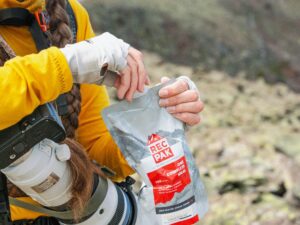
To bring his idea to fruition, Ziegler collaborated with sports nutritionists and food scientists, and together they developed an ideal blend of ingredients that could serve as a meal replacement. Ziegler also consulted with packaging experts to create a durable, lightweight pouch that people could utilize while on the go. In 2022, he launched his company, RecPak, which produces a powdered meal replacement product packaged in a durable pouch that requires only the addition of water.
Weighing 6.2 ounces (dry, including packaging), each RecPak meal provides 700 calories and contains approximately 50% carbohydrates, 25% protein, 25% fat, and 25% of a person’s daily vitamins and minerals. The meals are available in Chocolate, Vanilla Chai, and Coffee flavors.
According to the company, RecPak meals include fast- and slow-absorbing carbs to help fuel performance and maintain glycogen levels. To help prevent muscle breakdown, the meals also contain high-quality proteins. Additionally, they provide a balanced blend of monounsaturated fatty acids from sunflower oil, polyunsaturated fatty acids from flax, and saturated fats from coconut oil.
The special blend of ingredients ensures that people get balanced meals, which is often difficult during extended backcountry journeys, says Joy Seward, RecPak’s sales and marketing director, who also works as a mountaineering guide. According to Seward, the challenge is finding foods that are not only nutritious but also lightweight and don’t require a person to stop for an extended time to eat. She says backcountry travelers often cobble together meals that include jerky, protein powder drinks, nuts, granola bars, and dried fruit. However, during a long journey, people often fail to combine the right foods to get a proper blend of protein, carbohydrates, and fats.
“Normally, it’s really hard to get a balance of those daily for weeks on end,” she says, noting that RecPak meals offer a unique combination of nutrition and convenience.

Before Seward joined RecPak, she worked as a mountaineering guide and had her own desire to find more effective ways to eat healthy meals in the backcountry. “I was working for a year in the field, and my nutrition was going down,” she says. “I liked the job, but my health was being compromised by it.”
While guiding on the Matanuska Glacier in Alaska, Seward’s group endured a brutal storm. “We had to go three days without fuel, melting water with our bodies, just waiting in the hardest storm I’ve ever been in,” she says. When Seward finally got off the glacier, her boss asked her to do a quick turnaround and fill in for an injured guide who was supposed to teach an adult mountaineering course. Young and eager for opportunities, Seward hopped on a helicopter and flew out to meet her new client, Deed Ziegler.
“He had just made the RecPak product,” says Seward. During the mountaineering course, she and Ziegler discussed their shared interest in creating better backcountry foods, and Seward mentioned her desire to pursue a career in marketing. After the course ended, Seward followed up with Ziegler, and he brought her on board.
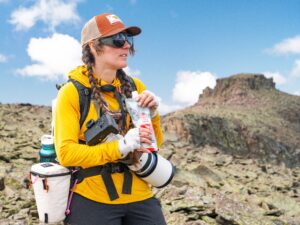
When Seward isn’t directing RecPak’s sales and marketing, she leads winter avalanche and ski courses as well as summer backpacking trips. During these outings, she uses RecPak meals to take in high-quality calories consistently without having to stop.
“If I’m having a long day and doing a 10-hour push, I’ll drink a sip to get around 100 calories every hour for consistent nutrition,” she says.
While people rely on RecPak meals for skiing, mountaineering, and backpacking, the products serve a variety of other activities that require adventurers to eat while on the move. In July, RecPak provided meals to five U.S. special operations veterans who competed in the World’s Toughest Row challenge in the Pacific Ocean. Representing the non-profit Range Oars Row, the team of veterans began their paddling journey in Monterey, CA, and traveled 2,800 nautical miles to Kauai, HI.
“They’re rowing 90 minutes on, 20 minutes off, 24 hours,” says Seward, describing the physical challenge the rowers faced. “They’re on a boat, it’s moving. They’re not heating anything up to eat, and they need to be able to put a lid on their food.”
Fueled in part by RecPak meals, the veterans completed the race in an impressive time of 35 days, 6 hours, and 59 minutes.
While the rowing challenge demonstrated the usefulness of RecPak meals, the company didn’t support the veterans just to promote its product. A primary goal was to assist Range Oars Row in its mission to raise awareness and funds for veteran mental health and suicide prevention.
With RecPack, Ziegler and Seward aim to lead a socially and environmentally responsible company that prioritizes people over profits.
“We want to run an ethical, mission-focused company first, and then we think the profits will stem from that,” says Seward, adding that the company not only donates to military veteran organizations but also supports first responders, teachers, nurses, and people in other caretaking roles.
Caring for the environment is equally important for RecPak, and the company is a member of 1% for the Planet, The Conservation Alliance, and the Access Fund.
“It’s always been my driving focus for RecPak to leave the world in a better place than we found it,” says Ziegler. “The places where people use RecPak are under constant threat, access is getting restricted, and wild areas are getting carved up. Supporting organizations like The Conservation Alliance and Access Fund means protecting the terrain where our gear gets put to work.”
While RecPak prioritizes the environment and people, it also needs to be profitable and is working diligently to expand its reach and increase sales. So far, online sales have been key to the company’s success, but Seward’s chief goal now is to expand the product’s presence in outdoor specialty stores.
“We want to be convenient for our users,” says Seward, explaining that people shopping at the last minute for a trip should be able to visit a store and grab meals. So far, RecPak meals are available in about 30 independent outdoor specialty stores.
As the company broadens its distribution, it is also improving its products. RecPak just introduced a redesigned pouch with a screw top that’s compatible with a Sawyer Squeeze filter. This change transforms the RecPak pouch into a reusable container for fluids.
With product improvements and wider distribution, RecPak can continue to make gains in the competitive food category of the outdoor industry. As is the case with any company, RecPak will face its share of challenges. However, the company’s unique product and social and environmental principles should appeal to outdoor consumers. The key now is to maintain momentum. Just like a mountaineer or a Marine on patrol, Seward and Ziegler just have to keep moving, regardless of the obstacles that lie ahead.
