The first time I met Paul Hendricks, executive director of The Conservation Alliance (TCA), I immediately wanted to be his friend. He has a kind smile, an approachable tone of voice, and he actively welcomes everyone at a table or running group into his conversations. I was able to join him on an early morning run in San Antonio the day after he led the fantastic Common Ground: Trails, Public Lands, and the Business Case for Protecting Nature panel at Switchback at the Running Event. Our conversation vacillated between the serious business of conservation and running stories that made me laugh so hard my cheeks hurt at the end of the hour we spent together running along the San Antonio Riverwalk.
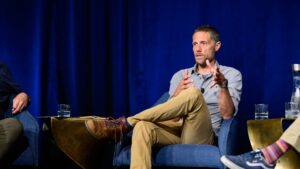 While Paul’s countenance is easy, his words are blunt about the stakes facing the public lands the outdoor industry depends on. “Our lands and waters are facing significant threats right now. We’re trying to figure out the best way to both defend what we’re having coming at us in the short term, but also think long term of how do we create a new narrative about our waterways and woodlands.”
Those threats are not abstract. TCA is tracking everything from summer public land sell-off proposals to a looming attack on the 25-year-old Roadless Rule, a policy that protects roughly 60 million acres of national forest across the country. If that rule is rolled back, the consequences would be felt immediately: 25,000 miles of trail, 8,000 climbing routes, and 700 miles of whitewater could be affected, along with the gateway communities that rely on them economically.
Hendricks is adamant that responding to these challenges requires a unified business voice. “The business voice for conservation is absolutely critical,” he said. “If we’re going to push back and convince current and future administrations that public lands are worth protecting, not just for biodiversity and climate, but for economies and jobs and communities, it’s the business voice that will do it.”
That belief is precisely what draws TCA to Switchback. The show is one of the few times each year when brands that depend on healthy trails, rivers, and public lands all end up in the same building. Hendricks isn’t there to deliver a feel-good speech; he’s there to recruit, organize, and turn the industry’s collective presence into collective power.
That power comes from the companies themselves. When Patagonia, Black Diamond, Brooks, Hoka, or a small specialty brand calls a senator and says, “This place matters to our business and our customers,” it carries a different weight than a traditional NGO message. And Switchback is the ideal environment to build that kind of alignment. Bringing the industry together in one physical space creates the proximity, shared language, and mutual dependence on public lands that advocacy coalitions require.
To make that coalition possible, Hendricks spends time dismantling the idea that conservation is inherently partisan. He likes to ask people a simple series of questions: “Do you like to hunt? Fish? RV? ATV? Go for a walk? Bird-watch? Climb? Backcountry ski?” All of those activities happen on public lands and are practiced by people across the political spectrum. Hendricks calls public lands “the great equalizer,” one of the few places where a billionaire and a broke 22-year-old enjoy the same access for the same price. For outdoor brands, understanding this helps reframe advocacy not as a political stance, but as protecting the infrastructure their business depends on. Switchback becomes a place where that idea can spread quickly, brand to brand, brand to retailer, conversation to conversation.
Of course, the word “advocacy” can still feel intimidating, especially for smaller companies. Many people associate it with lawsuits, boycotts, or internet fights. Hendricks wants to show that it’s far simpler. “At its basic form, advocacy is standing up for what you believe in,” he said. TCA offers an intentionally broad on-ramp to help brands feel confident taking that step. Their free Brands for Public Lands coalition provides plug-and-play language, background information, and calls to action. Member brands get coaching on when and how to speak up, and guidance on using their own channels to educate customers and employees. CEOs are also encouraged to sign letters or join fly-ins to speak directly with decision-makers.
This is also where Switchback strengthens TCA’s impact. Instead of learning these things in isolation, brands can sit face-to-face with TCA staff, ask questions, compare experiences with other companies, and understand how advocacy can fit into their workflow. And there’s a quieter benefit that comes from the show environment: safety in numbers. Hendricks uses a “tall poppy” metaphor—no one wants to be the lone company sticking its head above the grass in a volatile political moment. But when 160 brands representing billions in annual revenue stand up together, it becomes much harder to single any one of them out. Switchback gives TCA the venue to help build that kind of solidarity in real time.
This collective strength is not just for the big players. With only about 20 employees, Flagstaff-based Kahtoola doesn’t have an in-house advocacy department, and keeping up with shifting policy and land-use issues would be nearly impossible without help. “They keep us tuned into the issues that matter,” said Kahtoola’s Marketing, Communications, and Brand Development Associate Jimmy Hopper. “They provide building blocks, cliff notes on what’s happening, assets we can work from, and then we personalize that to our backyard.”
Kahtoola’s experience shows how TCA’s role extends far beyond generating talking points. Sometimes, TCA serves as a direct collaborator; other times, it acts as a connector. When Kahtoola began working on a film and communications strategy around the Ambler Road and climate impacts in Alaska, TCA introduced them to on-the-ground experts like SalmonState so they could craft messaging rooted in real local knowledge.
TCA’s ability to quantify the economic importance of public lands is just as important. Hopper regularly relies on their data when talking to other businesses or elected officials. “There’s a cause and effect,” he explained. “If we lose this place, you lose that revenue stream.” Advocacy becomes not just an environmental message, but a business case.
Despite the volatility of the outdoor market, Kahtoola has never considered reducing its commitment. The company supports 1% for the Planet, the European Outdoor Conservation Association, and TCA, and Hopper is quick to say that those investments aren’t optional. “Yes, things are volatile,” he said. “But that’s not a good enough reason to stop. It’s part of why we exist.” For him, TCA membership isn’t a marketing gimmick or a differentiator anymore. “The more people who do this, the better,” he said. “Donating is table stakes. What you do with that membership is what really matters.”
That sense of shared responsibility is exactly what Hendricks hopes to cultivate at Switchback. He wants to inspire and activate more brands to get “on the playing field,” to show that the risk of staying silent now outweighs the risk of speaking up, and to give companies concrete, approachable ways to start participating. The timing is urgent. The Roadless Rule, for instance, is a campaign with direct relevance to Switchback’s core audience—trail runners, specialty shops, and the brands that serve them.
So if you’re walking the Switchback floor in New Orleans this upcoming June, the invitation is simple. Think of TCA not as another logo to add to your footer, but as a partner in protecting the landscapes your business cannot live without. Talk to Paul. Ask brands like Kahtoola what this partnership looks like in practice. In a moment when public lands really are the great equalizer, the outdoor industry has an equally outsized opportunity to be the loud, united tall poppy.
Click here to learn more about TCA. Click here to join Brands for Public Lands.