 One of the most interactive education sessions I saw at The Running Event (TRE) last week was “The Accessible AI Playbook: Practical Tools to Inspire Retailers,” led by Big Peach Running Co.’s Steve DeMoss alongside The Run Free Project’s Rob Anderson. While the session was about AI, the vibe in the room felt very human. The presenters brought a heap of energy and the audience matched with curiosity, a little apprehension, and so many questions that nobody wanted to leave. In spite of the session being late in the day, audience members asked questions more than 15 minutes past the 4:30 PM finish.
Afterward, I interviewed DeMoss to figure out what, exactly, outdoor retailers could borrow from the experiments he’s running inside his own shops.
Big Peach Running Co. has 13 stores in total, mostly in metro Atlanta and North Georgia, and has built a sterling customer service reputation as a locally owned specialty chain. DeMoss manages a pair of Big Peach stores in the Atlanta area. He’s been in run specialty for about 20 years, and he’s the kind of person who spends his free time thinking about training curriculums, automation, and how local retailers can stay relevant in a world where shoppers show up with AI in their pocket. He’s also refreshingly honest about where the tech is genuinely useful and where it very much is not.
Here are five ways outdoor retailers can adapt what he’s doing in run specialty and make AI work on their terms.
One of the most reassuring things DeMoss said is that you do not need a computer science degree to use AI effectively in your shop. He sees AI less as something you “program” and more as something you talk to. The key is clarity and brevity. Inside his store, he coaches staff to explain what they want in ten seconds or less before they ask AI for help. That constraint forces them to strip a situation down to its essentials. It is the same skill set you use when you explain a ski to a customer in a single, honest sentence instead of wandering through the entire catalog in your head.
DeMoss compares it to the old “peanut butter and jelly” exercise from beginner programming classes, where you realize how much detail is hidden in what sounds like a simple instruction. Working with AI in English is similar. You learn to be precise about what you want, but you do it conversationally.
DeMoss uses AI to create authentic, locally grounded content that helps people find his stores without adding hours to his workweek. On a nice day, he goes for a walk in the woods, pulls out his phone, and talks into it about topics customers actually ask about like plantar fasciitis, flat feet, shin pain, how to pick between different categories of shoes. He does not worry about being polished. He just talks the way he would talk to a runner across the fitting stool. Once he has the transcript of that walk-and-talk, he uses AI tools to turn it into blog posts, website FAQs, and other written pieces that live on Big Peach’s site and Google Business profile. Over time, all of those pieces start to signal, to both search engines and AI systems, that Big Peach is a local authority on those subjects.
Outdoor retailers can lift this whole structure almost directly. Instead of overthinking your “content strategy,” hit record and talk about layering for your specific shoulder season, how you approach bootfitting wide feet, or what you recommend for a first backcountry kit in your region.
Let AI help with editing and formatting, but make sure the perspective is yours. What sets you apart is your demonstrated expertise in your geography. AI just makes it faster to get that expertise out of your head and onto the internet.
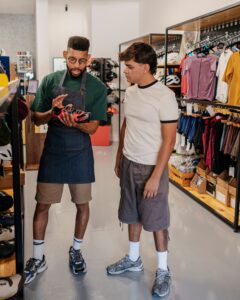 DeMoss is very clear that AI is not going to replace real mentorship in retail. What it can do is take the training you have built over years and make it much easier to deliver consistently.
At Big Peach, they had a backlog of training videos: orientation modules, biomechanics primers, walkthroughs of their fit process, explanations of shoe construction, and more. In the past, those lived as one-way content. Now, they feed the transcripts into AI and ask it to generate multiple-choice quizzes, short-answer questions, and even tiered “curriculums” that they label as bachelor’s, master’s, and PhD levels. New staff might answer basic questions about arch types or cushioning categories and veterans might be asked to write and defend a mini “thesis” on a topic that relates back to their daily work.
One of the trickier questions is how, and whether, to use AI in front of customers. DeMoss has already seen customer reactions ranging from people who want to explore options alongside a tool, and people who are put off by the idea of a salesperson leaning on AI during an interaction.
His solution in mitigating the negative reactions is to build a progression so staff can get comfortable long before they are using it in front of a customer. It starts privately, with employees using AI as a study partner while they try on products and ask basic questions. From there, they graduate to replaying real customer interactions into the system after the fact, seeing what it suggests, and thinking about what they might do differently next time. Only after that do they start using it in the back room, in real time, as a silent advisor while they pull sizes and consider alternatives. The final step is bringing it out into the open and saying to a customer, “Let’s explore this together,” especially when the question is complex or the product has a dense feature set.
The important part for outdoor retailers is not the specific tool but the ladder progression. Nobody should be fumbling around with prompts for the first time while a customer waits awkwardly in front of the counter. Give your team permission to practice, experiment, and build trust with the tool privately. Then decide, as a shop, where you are comfortable drawing the line for customer-facing use.
If there is one back-of-house area where AI is already changing DeMoss’s day-to-day life, it is ordering. Not because the system is making decisions for him, but because it is finally doing the boring data work he used to have to slog through manually.
Using exports from his point-of-sale system and some basic scripting that he built with AI’s help, DeMoss now gets a daily email for certain brands that shows exactly what sold in each store yesterday. It also lets him know how many units are on hand by style, size, and color, what is already on purchase orders, and a suggested reorder quantity for each line. For a brand like Brooks, where fill rates are strong, he can move toward genuine daily ordering without spending his entire life in spreadsheets. For brands with spottier availability, he still uses the report, but he knows to treat the suggestions more cautiously.
The crucial thing is that none of the nuance has gone away. He still has to know whether a shoe is about to be updated, whether a sale was a one-off special order in a color they do not want to carry, or whether they should deliberately let a model sell down. Those are judgment calls rooted in experience and strategy. What AI has done is remove a big chunk of the friction between “I wonder what is happening with this category” and “I am looking at a clean, accurate snapshot that helps me decide what to do.”
For outdoor retailers, the transferable idea is simple: Anything that lives in your POS and currently requires you to run three different reports, copy-paste, and hand-format into something readable is now a candidate for automation. AI can help you write the glue code or at least outline the logic, even if you are not a technical person. You still own the decisions. You just get to spend more of your energy on them, and less on wrestling CSV files.
DeMoss is the first to admit that none of this is “run specialty only.” Training, storytelling, on-floor decision-making, back-office reporting are shared challenges across every specialty vertical. AI, in his framing, is not a threat to the core value of a good shop. It is a way to strip away some of the drudgery, raise the floor on staff knowledge, and make it easier for curious, well-prepared customers to find you.
Or, put more bluntly: AI can read every tech sheet in the world, but it cannot lace a boot, feel the edge of a ski on refrozen corduroy, or listen to the nerves in someone’s voice when they tell you they are buying their first backpack for their first big trip. If you use it to create more space for those conversations, you are not replacing what makes your store special. You are protecting it.