
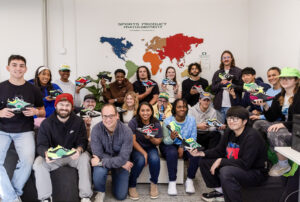
After earning her undergraduate degree in mechanical engineering, Jessie Scilingo began pursuing her dream of working in the outdoor industry. While interning with several outdoor brands, she realized she needed to know more about the product development process.
In the fall of 2019, Scilingo enrolled in the University of Oregon’s Sports Product Management (SPM) master’s program, which teaches every aspect of creating sports and outdoor products and bringing them to market.
“The SPM program felt like it could provide me with a more balanced understanding of not just product creation but the business side of the sports and outdoor industry,” says Scilingo.
Joining the SPM program proved fruitful for Scilingo, who received her master’s degree in 2021 and got a job in product development with The North Face. “Being able to speak about each part of the business really helped in the interview process,” she says.
The SPM program’s unique curriculum and exceptional student experience make it an ideal springboard for anyone seeking to work for outdoor brands.
In 2015, the SPM program was established through a partnership between Dr. Roger Best, a University of Oregon researcher, and Ellen Schmidt-Devlin, a former track athlete who worked for Nike for 27 years. Best and Devlin identified a need for a curriculum that teaches people how to bring a product from its initial idea to the consumer market.
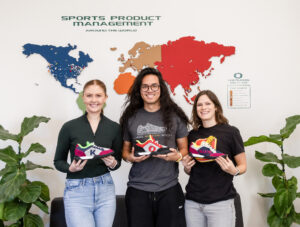 They developed a master’s program based on an 18-month product development lifecycle. It begins with students determining the needs of consumers and continues with every stage of the lifecycle, including product design, manufacturing, marketing, and merchandising.
One of the most critical aspects of the program is that the work is practical, as students develop a real product for a company in the sporting goods or outdoor market.
“They determine a pain point, something that needs to be solved for a consumer,” says Francine Hatton, associate director of marketing and strategic communications for the SPM program. “For example, one team in the past developed a hiking shoe that had a collar on it, solving the issue of people getting rock pebbles in their hiking shoes. The students come up with a solution to solve the need and build the product.”
 As students develop their products, they have access to resources and opportunities that make their learning experience unique.
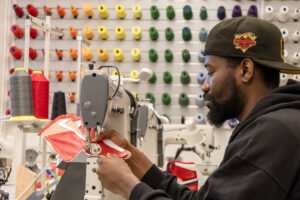
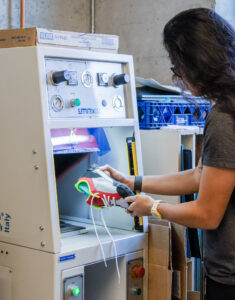
For example, students can utilize the university’s SPM Innovation Lab, which has specialized equipment, including sewing machines, laser cutters, and 3D printers. Using these tools, students can design, manufacture, and test prototypes for apparel, footwear, and equipment. Additionally, the university maintains relationships with factories worldwide, allowing students to build prototypes of products they have developed.
Another critical aspect of the program is its focus on team-based learning.
“I think the most useful part of the program was that you worked in a team for the entirety of the program to create a product,” says Scilingo. “It allowed you to apply what you were learning in a real-time situation, from ideation and how you would start your brand to product creation, supply chain, marketing strategies, merchandising, and more.”
The teams include students with varied educational backgrounds, says Jennifer Nolfi, director of the SPM program. “Our students come in with a diversity of undergrad degrees— kinesiology, engineering, design, marketing, business. So, we make sure those different disciplines and experiences are represented in the teams,” she says.
The diverse teams help students better understand each job function, says Scilingo. “It also teaches you how to manage different communication styles, work within a diverse team, and be able to support or even challenge teammates in a healthy way,” she says.
As students learn to work within a team and an organization, they also gain a broader view of the world of product manufacturing. “This is a global industry,” says Nolfi. “So, another important component is that our students go to Asia to see the factories and the scale of production.”
This September, students and instructors traveled to Vietnam to visit footwear and apparel factories, and then visited Tokyo, Japan, to study the local retail market.
Additionally, the university collaborates with a select group of factories in Sri Lanka and other parts of Asia, offering students the opportunity for paid internships.
While the program partners with overseas manufacturers, it also integrates professionals in the U.S. sports and outdoor industry.
“Ninety-five percent of our instructors are from the industry, and some are currently still working in the industry, so students are learning real, applicable business knowledge,” says Hatton.
For example, the instructor for the program’s sourcing and costing class is Eric Goldner, a senior supply chain executive with over 25 years of experience at companies such as Nike, Keen, and Columbia Sportswear Company.
“His class was going on when the whole tariff thing started,” says Hatton. “So, he was able to immediately adjust his curriculum so that it was relevant to what was going on in the real world, which is very unique.”
Industry professionals not only teach classes but also serve as mentors. “Every student is paired with a volunteer industry mentor who provides guidance and support throughout the program,” says Nolfi.
Each year, the program also features approximately 40 guest speakers who work in the sports and outdoor industry.
These industry connections are possible in part because of the university’s location. “We’re in the hub of the sports product industry,” says Hatton. “There are over 900 sports- and outdoor-related companies within Oregon, so that leads to networking opportunities.”
Perhaps the most important industry partnership concerns the students’ capstone projects and final-term consulting projects.
Throughout the program, teams work on the capstone project to design a market-ready product for a specific brand. Then, they present their concept, including a prototype, to faculty, students, and representatives from the company. In some cases, the company produces the product and introduces it to the market. Additionally, students can collaborate with instructors to license or patent the inventions they develop during the capstone project.
In their final term, students also do a separate project with a brand, where they identify a challenge that the company is facing and collaborate with the brand to develop a solution. This work doesn’t necessarily involve creating a product,” says Hatton. For example, students might help create a marketing strategy. “At the end of the term, the brand often takes the student’s recommendation and runs with it,” she says.
The capstone projects, consulting projects, and other coursework introduce students to a wide range of disciplines and skills, making them aware of the full spectrum of potential job opportunities. Students who complete the program go on to secure positions in various fields, including product-line management, merchandising, marketing, and sustainability.
Due to the program’s high quality and the involvement of industry professionals, a significant percentage of graduates secure jobs with sports and outdoor companies.
“Ninety percent of our over 500 alumni are working in the industry,” says Nolfi.
While the job market is currently tight, graduates of the SPM program have an advantage due to their breadth of knowledge across the entire product creation lifecycle.
“Brands have told us they come back to us for our students because they’re far above anybody else that would come in with no experience or limited experience,” says Hatton. “Our students know a little bit about every function. So, they can show up in the boardroom and talk to anybody that’s sitting around the table.”
