
A few years ago, 40 acres of land near Five Mile Creek in Dallas stood empty, a massive vacant lot in the predominantly Black community of Highland Hills.
However, the once-ignored land is now a lush green space, complete with playgrounds, trails, and picnic areas. This June marked the opening of Judge Charles R. Rose Community Park, named in honor of a Black justice of the peace who was a longtime advocate for the Highland Hills community. 
The park is the result of a partnership between the City of Dallas, the Texas Parks and Wildlife Department, and the Trust for Public Land (TPL), a 53-year-old national non-profit organization that creates parks and protects land to connect people with the outdoors.
Going back to its early days in the 1970s, the TPL has partnered with the Black community in numerous ways. However, in the last few years, it has increased its efforts to highlight Black history and culture in its public land projects.
In 2022, TPL appointed Dr. Jocelyn Imani as its first Director of National Black History and Culture. In a statement, TPL noted that only 2 percent of the 95,000 sites listed on the U.S. National Register of Historic Places focus on the experiences of Black Americans, adding, “More work needs to be done, and TPL hopes to help continue leading those efforts with communities across the country.”
By focusing on history and culture, the TPL can strengthen the relationship between Black populations and public lands. For example, in Highland Hills, residents may feel a greater connection to their new park when they learn about the impact Judge Rose had on the community. If they develop an affinity for the park, they will likely frequent the place, improving both their physical and mental health.
“If we bring black history and culture to the table and make places accessible and relevant, we’ll see how people are transformed by the space being preserved,” says Imani. “We’ve seen that time after time.”
TPL’s history and culture initiatives also aim to raise overall awareness of the significant contributions that Black people have made to our cultural landscape. As Imani points out, “Black culture has fueled this nation for generations.” If the outdoor industry wants to build stronger ties with Black Americans, it should better understand their past and present, as well as the forces that affect their relationship with outdoor recreation.
Solving Community Issues
With its public land projects, the TPL not only bridges the gap between Black residents and green spaces but also strives to address a range of issues impacting underserved communities. 
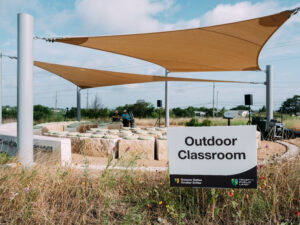
“We want to make the outdoors accessible and relevant to all audiences, and I want to take that a step further,” says Imani. “How do we use public land to solve community issues? We know that access to public land and the outdoors contributes to improved health outcomes. We know it helps with climate outcomes. We know that it gives people a sense of belonging and connectedness. It puts people in a sense of place.”
As the TPL endeavors to improve communities, it undertakes a wide range of work, including conducting research, examining public policies, enhancing infrastructure, and raising funds for public land projects.
“When communities haven’t had equal access to the outdoors, it’s not by chance. There are policies involved,” says Imani. “So, we take a step back and look at policy, whether it’s on the federal, state, or local level.” In some cases, TPL conducts research to identify flaws in policies and publishes its findings in white papers and other documents. This policy work can lead to improvements in regulations and the launch of new public land projects. When the TPL works to affect laws in a city, it often works with the mayor’s office, the city’s parks department, and local non-profits.
While TPL helps to change laws, it also collaborates with cities to enhance infrastructure in underserved communities. Across the country, TPL has helped overhaul more than 350 playgrounds with equipment that doesn’t get extremely hot during warm months. “If you think about that old school blacktop and hot slide, it can be, on average, about 20 to 30 degrees hotter than the surface temperature, and it’s not good for the children,” says Imani.
According to Imani, giving children access to the outdoors is a priority for the TPL. “We are securing safe places to play,” she says. “We want every American to have access to a park within a 10-minute walk. We know that about 100 million Americans don’t have that access, including about 28 million children. So, we are trying to fix that.”
Of course, fixing things requires funding, and the TPL’s work includes raising money for public land projects. In Dallas, the organization raised $3.7 million to buy the 40-acre plot that is now Judge Charles R. Rose Community Park. Since its launch in 1972, the TPL has raised over $110 billion in funding for parks and public lands, creating more than 5,500 parks, trails, and schoolyards.
Finding Common Ground
Whether the TPL is developing a park or fixing a playground, the true power of its work is the ripple effect that transforms communities.
“We know that access to a park and shared space leads to the formation of a shared identity, even by people who don’t have things in common,” says Imani. “If they regularly interact in a park, they’re going to develop a shared identity that leads to shared goals and shared organizing.” 
While the TPL helps neighbors find common ground, it can also foster stronger connections between the Black community and the outdoor industry. If industry professionals better understand the forces affecting Black people and their relationship to public lands, they can engage with them more effectively and partner to pursue shared goals.
Ultimately, the TPL’s focus on history and culture serves to unite all Americans who appreciate parks and other green spaces.
Of course, Imani realizes that, in today’s political climate, any effort to highlight the Black community might be labeled a “DEI thing.”
“But it’s not,” she says. “Because what we know for sure is that Black history is American history.”
