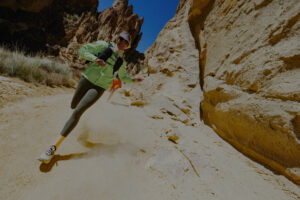
In Keen’s early days, some 20 years ago, the company experimented with a trail-running shoe, says Keen Senior Vice President Scott Labbe. However, this summer, Keen launched its first extensive push into the trail-running market with the introduction of the Seek shoe.
Trailheads talked with Labbe about the development of the shoe and Keen’s plans to expand its trail-running offering. Here are highlights from that conversation:
 A: Just the word ‘trail’ alone. It’s always been part of our Keen DNA, right? Who knows trails better than Keen, which has built shoes for the trail for 21 years? We’re all about protection, we’re all about durability, and, of course, outdoor authenticity. With trail running being one of the fastest-growing outdoor sports, we saw an opportunity to serve that fan, the runner.
A: Close to three years ago. We gave the innovation team the cerebral horsepower and bandwidth to figure this out on their own without any distractions. Anybody can just pull together a quick running shoe. I’ve been with other brands where it was considered a quick strike, and in six months, they had a running shoe on the shelf. But Keen really wanted to do it the right way, the authentic way.
A: We worked with a ton of expert runners to test and retest. I think we went through over 20 molds to get to our final stage. Our internal developer, Scott Robertson, who’s the fiercest trail runner that I know, ran a total of 925 miles in our Seek shoe. We also partnered with Heeluxe and used their lab data to ensure we nailed everything from propulsion to acceleration, deceleration, and stability before we even came close to going to market.
A: The brief was to design a trail shoe that’s protective and durable, and we wanted to design it for the everyday adventure runner. The market was polarized between race-day shoes and casual trainers. We saw an opportunity, or a gap, that could be filled by a real trail shoe that could be used for 900-plus miles, with a roomier forefoot toe splay for long-distance comfort. We also wanted to deliver the traction across gravel, mud, and rock that trail runners would expect. It was all about durability. If we went down the road of building the lightest-weight product, we just wouldn’t get that same result.
A: We wanted to build the shoe so that the everyday, common, 99% of trail runners would want to wear it. Our internal insights team used different platforms to analyze designs and get feedback from a diverse group of folks of all ages, weights, shapes, and stances.
A: The marketplace seems to be trending toward a more simplistic and minimalistic look—not just in stack height, but even just the cleanliness of the shoe. They’re definitely looking for cleaner, leaner uppers, and usually the design flash is happening in the midsole and the outsole as opposed to the uppers.
We thought it was super important to have branding on our running shoes. This is one of our first franchises with our “K” mark branding. We tried to do it almost 20 years ago, and we brought it back to life—it just represents speed.
 A: We didn’t want to go flashy with all kinds of exposed technology. We wanted to put the efforts and technology where it mattered, which is the foams, the last, the toe shape, the fit, and the ride of the shoe.
With the Seek, we focused on creating an ultra-durable midsole with high-energy rebound. We spent a lot of time researching the (midsole) foam and the exact curve needed between heel and toe for propulsion, acceleration, and deceleration, and to increase the productivity of your gait. We also did a lot of R&D on the last to have the proper room for the toe splay, because the heel-to-toe action and push-off are so important for running.
For the midsole, we use a maximum-energy rebound Pebax foam. It’s built to last on any rugged trail, or even the road if needed. For the outsole, we used 4-millimeter lugs and high-abrasion Keen All-Terrain rubber, which we’ve been developing for over five years.
A: Number one, we’re PFAS-free. Number two, no solvents were used for this shoe, which is a big deal. Solvents are typically used in the waterproofing process or the stock-fitting process to bond an outsole to a midsole. Also, everything on the shoe is recycled. So, we’re proud that we’ve built the cleanest shoe in running.
A: Number one is to ensure that the people building the shoe are subject matter experts. Also, we’re all about community, so we’ve seeded hundreds of pairs of shoes to grassroots ambassadors, run clubs, and specialty shops. We’re not chasing visibility through celebrities; we’re building credibility through real trail runners. We’ve been doing that for 16 months, and it’s really paved the way. We’ve recently launched wholesale with partners like REI, Scheels, and Rogue Valley Runners, and we’ve already seen high-double-digit sell-throughs.
A: We have a pretty aggressive timeline and scale for trail running. We’re going to expand a franchise called Roam and another franchise called Wander, where we introduced a minimalist barefoot approach. Our vision is to go big with our Speed of Life platform, Keen’s fastest and most athletic performance category, anchored by trail running (including the new Seek) and minimal/barefoot concepts. It’s where Keen incubates new “fast and light” technologies, constructions, and materials, with the goal of combining speed, cushioning, durability, and trail protection. So, we have big hopes, but we also have a great plan, great people behind it, and great testing facilities and innovation to propel us forward.

To learn more about the Seek shoe and Keen’s plans for the trail-running category, visit the Keen booth at Switchback at TRE, which will be held December 2-4, 2025, in San Antonio, TX, at the Henry B. González Convention Center.