
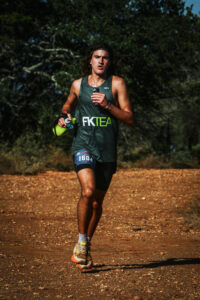
 In the heart of New Orleans—a city that famously sits below sea level—Paul Loper is preparing for the “Race Across the Sky.” This August, the 27-year-old will compete in Colorado’s Leadville Trail 100 Run—an ultramarathon that reaches 12,600 feet of elevation—aiming to prove that a flatlander can compete with the world’s best mountain athletes.
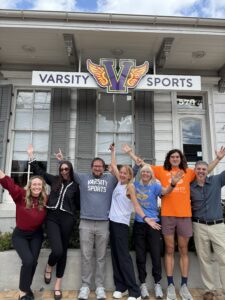 When Paul isn’t training, he works at Varsity Sports, the iconic running specialty store in the Big Easy. The Trailheads and Switchback crew caught up with Paul during the Louisiana edition of our Roadshow, where we spent a week visiting specialty retailers in the New Orleans area. During our time at Varsity Sports, Paul shared that his journey to qualify for the Leadville 100 has been deeply intertwined with the store. Growing up in rural Livingston Parish, he saw Varsity Sports as the go-to place for high-performance gear in a region with few specialty shops. Since joining the staff in late 2020, he credits the shop’s culture—and its owner, Jenni Peters, a professional marathoner—with providing the foundation for his elite-level training.
“I like to tell people I got my degree in running just from the years of working here,” Paul says, explaining that his training was only sustainable because he was “working at a store where people care” deeply about the sport. He credits the staff—who he says “really are like a family”—with helping him weather the mental and physical toll of preparing for the Leadville 100. This support includes a rare level of work flexibility, with the shop accommodating his training schedule and even providing paid time for his conditioning sessions.
Located in a converted house, Varsity Sports lacks the sterile, corporate feel of a typical showroom. Walking through the front door feels less like entering a retail space and more like stepping into a friend’s living room, an atmosphere that perfectly mirrors the culture Paul found there.
This sense of belonging provided the perfect environment for Paul to turn his passion into a profession. He has mastered the nuances of educating customers about footwear, gear, and training techniques over time. The knowledge base and industry connections gained through this job have helped Paul build relationships with brands that keep him supplied with gear in his personal pursuits. This is a significant advantage for an athlete who can burn through a pair of shoes in just a few weeks. Financial partnerships, such as his sponsorship with the beverage company FKTea, further support his efforts by funding essential travel and racing costs.
Being a sponsored athlete certainly has its perks. However, long-distance running gives Paul much more than free gear, drinks, or opportunities to stand atop a podium. Most notably, it gives him peace of mind.
While Paul ran cross country in high school, his return to the sport during the COVID-19 pandemic was driven by a need to improve his mental health. After a difficult relationship and a period of depression, he found that hitting the trails gave him the space he needed to clear his head and find himself again.
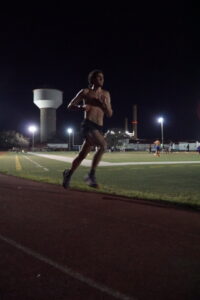 “For me, COVID was the most life-changing thing in a positive way,” Paul reflects. “It made me directly confront myself…and obviously the running was the vessel, honestly.”
By working through his issues, Paul has developed mental toughness and a healthy perspective. To him, the physical suffering of a 100-mile race pales in comparison to the weight of mental health struggles. He views the ability to push his body to its limits as a “total privilege.”
This mindset found a natural home at Varsity Sports, where the shop’s motto—“Run Hard, Live Easy”—mirrors his personal commitment to balancing extreme physical effort with a stable, healthy mindset. “You can get by skimping on self-care, but you’re going to hit a wall, you’re going to get injured,” Paul cautions. “So, you have to love yourself and be careful in a good way.”
While every ultrarunner must navigate a gauntlet of physical and mental hurdles, Paul faces the added challenge of training at sea level for a high-altitude race. To prepare in “pancake flat” Louisiana, Paul relies on intense treadmill sessions that mimic the vertical gain of Colorado’s peaks in a single hour. He also scouted a few hilly pockets in the greater New Orleans area. There, he repeatedly grinds out the elevation gain needed for the race.
His current preparation is going well, but Paul’s journey to the Leadville 100 wasn’t without hurdles. Earlier this year, he qualified for the race by competing in the Austin Rattler 50K. It turned into a grueling day of heat-induced cramping and hydration issues. Despite setbacks, he finished sixth overall and earned the first-place “coin” for his age group, securing his Leadville spot.
For years, severe cramping often derailed Paul’s races, and at first, he blamed dehydration. However, a conversation with mentor and Louisiana ultra-runner Walker Higgins shifted his focus. He looked beyond his water intake to the actual chemistry of his sweat.
Paul discovered he is a “salty sweater,” a trait that is likely genetic after observing his father’s similar struggles. This realization transformed his approach to race day. “Once I got my sodium in check, I stopped cramping during big races,” Paul says. “I’ve DNF’d (Did Not Finish) races from cramping before because it was so bad. But now I know I need almost two grams of sodium an hour, which is a lot of salt.” As Paul drinks to stay hydrated, he also consumes Carbs gels, which have high sodium content that his body requires to function under extreme conditions.
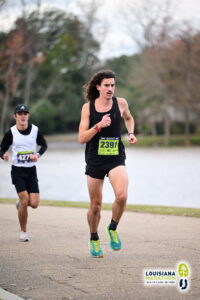 Training and staying hydrated in Louisiana is especially tough. Runners often face humidity levels between 80% and 100%. When humidity is high, sweat can’t evaporate from your skin. Since evaporation is how the body sheds heat, your internal temperature can rise to dangerous levels. This can happen even at mild temperatures like 85 degrees.
However, Paul views the oppressive humidity of Louisiana as a strategic advantage rather than a hindrance. While the Rockies present the challenge of thin air, he says the New Orleans humidity feels like a “physical weight” that requires a different kind of endurance. By learning to “keep your head together” while training in what he calls “95-degree soup,” he believes he’s developed a level of mental callusing that perfect weather conditions simply can’t provide to him.
While Paul relies on proper hydration and nutrition for his training, he also leans on a dedicated community of runners to power through the difficult miles. He is a founding member of “The Reapers,” a group of about 50 New Orleans runners that meet for workouts on a precise one-mile loop through a Metairie cemetery. The group’s steady expansion mirrors the rising popularity of ultrarunning across the Gulf South, as more local athletes seek out the mental and physical extremes of the trail. While The Reapers have steadily grown, Paul emphasizes that they don’t aim to be a large club and don’t promote themselves or seek out potential members. The group’s philosophy, “own the shadows,” prioritizes grassroots efforts over an active social media presence.
Despite his low-key approach, Paul appreciates local runners noticing him and cheering him on. This support offers him a “mental reserve” for truly grueling races. At the same time, he feels a sense of destiny in his pursuit of the podium. He recently learned that his surname means “a person who runs.”
“I feel like it’s how I honor my family, honor my ancestors, honor the people who came before me that gave me the opportunity to have a body in the first place that can run,” he says.
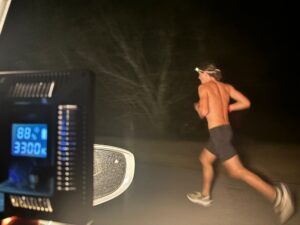
Three weeks before the “Race Across the Sky,” where the course never drops below 10,000 feet, Paul will arrive in Colorado to acclimate to the high altitude. While finishing the Leadville 100 is a monumental feat for any flatlander, Paul has his sights set higher. He aims to be the first runner from Louisiana to secure a top 10 finish at the event. And if things go well, maybe he’ll even surpass that benchmark. “The podium is like the big moonshot goal,” he says.
For Paul, the Leadville 100 is more than a physical challenge; it’s a milestone in his journey to reclaim his mental health. After navigating depression and personal upheaval, his presence at the race will be a victory of the mind as much as the body. Paul’s true success won’t be measured by the results alone, but by his ability to balance a gritty performance with a healthy mindset. As he runs through the thin air of the Colorado Rockies, he’ll carry lessons learned in Louisiana’s humidity. Living out the Varsity Sports motto, he’ll carry the belief that you can only truly run hard once you’ve learned how to live easily.
