For the first time in history, viewership for the women’s final at the iconic mountain race Ultra-Trail du-Mont Blanc World Series was higher than the men’s viewership.
“The men that I am in contact with and interact with are just as excited to follow the women’s races as they are the men’s races now,” says Abby Storer, a mountain runner, fitness trainer, and content creator.
The attention is warranted. Women are having an astounding year in trail running, with breakthrough performances adding up across the sport. A few highlights in 2026 include:
And that’s just the beginning of it. Anyone you ask will say women are crushing it in trail, but this isn’t a sudden breakthrough nor the product of a single standout season. Women have always been excellent on the trail. What’s changing is their visibility and how often their accomplishments are being seen, documented, supported, and celebrated.
“Like a lot of things, information tends to breed more action so the more these stories get told, I imagine the more we’re gonna see women’s racing continue to evolve and develop and do really interesting things,” says David Callahan, co-CEO of UltraSignup, the leading platform for trail races and ultramarathons in North America.
Several forces are fueling the fire. Social media has made it easier for athletes to share their performances, turning once-niche accomplishments into viral moments and giving more women visibility within the sport. At the same time, more inclusive athlete contracts and sponsorship policies have made it possible for women to stay in the competition, rather than stepping away when life circumstances—particularly pregnancy and parenthood—intersect with their careers.
Records are the most visible evidence of the shift, but women in the sport say they don’t want to be boiled down to a single moment or only their best moments; they want to be recognized as the serious competitors that they are, and have long been, and afforded the same respect and opportunity as their male counterparts.
If it feels like more women are competing in trail running than ever before, it’s because there are. That, coupled with excitement around women getting recognition in a sport that has historically overlooked them, has created a powerful cultural narrative around the rise of women in trail running.
 Looking beyond the cultural momentum and at the data, journalist, coach, and podcast producer Zoë Rom points to competition density as a factor. She says more elite women are entering ultrarunning, particularly former Division I athletes in their athletic prime. While the course records they’re breaking are impressive, they aren’t evidence that women are suddenly superhuman; the records were vulnerable because the previous women’s field simply wasn’t as deep.
Only a few years ago, when the sport was less visible and lucrative, it didn’t make much sense for female athletes to choose trail running as a path, Rom says. “Why would you waste your golden years wandering around in the woods for no money and no glory?” Rom says. “But now we are seeing the influx of money and influx of attention raising the profile of the sport.”
Plus, the sport is becoming more accommodating to women’s lives. For many women, athletic prime overlaps with reproductive years, and sponsors, media, and races are beginning to catch up with—and respect—the realities of pregnancy and parenthood.
In 2018, ultrarunner Sophie Power famously ran the UTMB course while breastfeeding her three-month-old son because the race refused to let her defer her place after giving birth. And it was only 2025 when ultrarunner Stephanie Case won the 100K Ultra-Trail Snowdonia after giving birth despite losing her elite ranking while she took a hiatus during fertility struggles.
In the last four years, notable races like UTMB World Series, Hardrock 100, Western States 100, and High Lonesome 100 have implemented pregnancy and parental deferrals for all genders. (The High Lonesome 100 also has a 50/50 split lottery between men and women.)
“Now it’s more seen as admirable instead of shameful to be a mom and to have children and to still chase your dreams,” says Storer, who had her son in August 2025.
Rom, however, cautions that the “women are superheroes” narrative can often flatten into a “women must do better in order to receive attention” narrative when really women shouldn’t have to outperform men in order to earn attention, time, and money in the first place.
The risk is leaving other women and identities out as the field grows deeper.
There once was a time when women had to fight to be on the cover of a magazine. As marketing becomes more representative of the community, that’s less true today—though Storer says it’s still difficult to find high-quality videos of female runners while footage of male runners is plentiful when she’s researching her informational videos.
But visibility is still far from evenly distributed. Women of color, in particular, remain underrepresented in more than just ads. Activist, author, and athlete Sabrina Pace-Humphreys, along with five other people, started Black Trail Runners in 2020 to increase the inclusion and participation of Black people and people of the Global Majority in trail running.
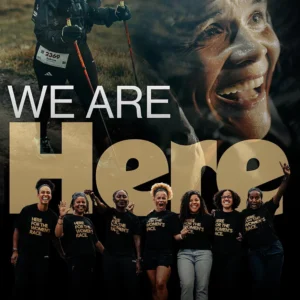 Pace-Humphreys is also one of six Black British women featured in the new film We Are Here, which follows them through the 2025 UTMB World Series Finals in Chamonix.
This year at UTMB, Pace-Humphreys says she saw more Black and brown people in Chamonix than in years past. Surrounding her at the starting line though, she counted five Black men but could not easily identify another Black woman.
“What has been forgotten is women are not a monolith,” Pace-Humphreys says. “We are a beautiful plethora, a beautiful rainbow of intersection, and what works for you in terms of access and representation might not necessarily speak to me.”
She continues, “If we just paint broad brush strokes for all women and say, ‘Well if we put this in place, that’s gonna bring her to the start line,’ it just doesn’t.”
Grassroots groups like Black Trail Runners, which have been working to improve representation since long before 2020, deserve much of the credit for bringing these issues to the forefront. But Pace-Humphreys says meaningful change will also require sustained investment from global corporations with the resources to reach and support a much broader audience. Representation at the leadership levels matters, too.
“If the initiatives that attract women were really all that they could be, we would see more Black women on the start line, we would see more Black women in races,” Pace-Humphreys says.
As the sport grows and the field of competition deepens, more women will inevitably achieve at the highest levels. Fast times will always be worth celebrating, but the bigger victory is a diverse community that feels connected, supported, and welcomed within the sport.
This article is featured in The Running Event 2026 Event Guide. Click here to explore the full guide to plan your experience this December 1-3, in San Antonio.